Monday, July 5, 2021

Statement of Educational Philosophy

* I have recently received several requests from educators and historians asking to see my Statement of Educational Philosophy, so I have decided to post it on here. Since my pedagogy is continuously evolving, my statement frequently changes. *

History is magnificently unique in that it is a very interdisciplinary subject, useful in many different contexts. By the time a student leaves my classroom, I expect that they will be able to take with them the fundamentals of writing, presenting, researching, and analyzing historical texts. They can then apply those skills to future problems in whatever degree and career they choose to pursue. In my classroom, students will be able to nicely fit in the shoes of a historian. They will be able to digest material on the history of the United States and the world, and receive the tools to become knowledgeable citizens who want to change the world. I also expect that my students will be curious and engaged learners, and not be afraid to ask stimulating questions.

My sincere interest in American history stems from my elementary days. Despite a severe speech impediment as a child and several learning disabilities in elementary and middle school, I am incredibly proud of myself for 'sticking it out' and graduating with my history M.A. in 2018.


The foundation of my teaching philosophy is that I care deeply about my students, and see them first as the humans they are, with lives and interests outside of the classroom. I enjoy conversing with my students during passing periods and office hours, and I take immense pleasure at mentoring them and offering graduate school and career advice. I am also known to be a loud and proud spectator at my students’ athletic games and music concerts (pre-Covid… and now, post-Covid since everything is gradually re-opening), earning me the nickname “the crazy professor” by several of my Texas A&M-Commerce colleagues and former students.

Inside my classroom, I always work to foster a welcoming, inclusive environment, starting on day one. I make it a priority to learn every student’s name and say their name whenever I call on them during the semester. Since small-group discussions are common in my lesson plans, students get to know each other (and bounce different ideas off one another). These collaborative approaches help my students and I gain a mutual respect for one another, as well as their peers. Given that a courteous environment is cultivated, I aim for my students to feel more confident asking questions in front of the class. I maintain the mantra there are no stupid questions, and encourage my students to speak up since it is very likely someone else has the same question. Most importantly, I retain the belief that by being an engaged learner, anyone can succeed in my classroom. It does not matter where you come from nor your educational background, you and your questions are always welcome.

I thoroughly enjoyed my stint as a speech and debate instructor at Duke TiP in June-July 2018. I shared my knowledge with a group of talented, high-flying middle-school scholars.


On top of fostering students’ respect for one another in the classroom, I also elicit as much activity from my students as I can during the lectures. I begin each lesson by summarizing what we covered in the previous class (and summarize the material at the end of that lesson too). Furthermore, I ask the students if there are any questions from what was previously taught or if there was a concept that was unclear. This open floor strategy at the start of class ensures we all understand the previous class’s material prior to building on it. I never want a student to dread this subject because “history lectures are long-winded”; history is far more profound and moving than most people realize. Consequently, I believe history is better learned through short stories. My lectures are composed of succinct, compelling anecdotes that chronicle the histories of all Americans, including Hispanic Americans, African Americans, Asian Americans, Native Americans, immigrants and women. Each enthralling story is told in an enthusiastic way and is complemented with a variety of captivating, physical props, such as copies of primary documents, and antique and historical objects (including one of my favorites when I discuss the 1960s, a 1964 campaign doll of Lyndon B. Johnson).

I have found that many of my students are visual learners so I frequently bring historical objects and antiques to class in an effort to 'bring history to life.' I showcase my LBJ bobblehead in this photo.


Visual learners are also given tools to succeed in my classroom. PowerPoint presentations with black-and-white images of important events in American history, as well as colored portraits of historical figures accompany the lectures. Furthermore, I frequently draw battlefield and street maps, as well as statistical diagrams on the white board to provide my students an all-encompassing picture of what happened at that moment in time. Occasionally, I sport a cowboy hat or costume dating from the time period we are talking about in class (including Texas Revolution and Civil War outfits), which further amplifies a student’s ability to envision a character’s appearance from American history. I endorse note-taking in my classes since these scribes are usually the ones who retain the information and perform well on the content quizzes and unit exams. Moreover, I encourage my students to critically think like historians by spending several classes discussing dense scholarly texts that examine different authors’ interpretations of a subject. At the end of the semester, my students engage in an historian’s most distinguished craft: writing. After utilizing technology and a variety of primary and secondary documents at the university’s library, my students are required to create and defend their own thesis in a research paper. Additionally, students polish their oral communication skills by presenting their findings to the class.

I enjoy visiting historical landmarks and 'feeling the ghosts.' I share these stories with my students and encourage them to tour the battlefields, residences, and factories where our great American heroes once worked and lived in. One of my favorite vignettes to share was the time I received a back-stage tour in the Churchill War Rooms in London and got to seat in Winston's chair (the chair's handles were scratched since the PM often dug his fingernails into the wood when he was stressed during the war!).


After outlining how I approach my current classroom and beyond, one thing that I constantly keep in mind is that I am learning too. My pedagogy and instructional methods are continuously evolving. There will always be methods where I can improve what I can do for my students, and I will actively seek these out. One aspect I consistently seek to improve on is student feedback. Currently, I study my assessment tools to see whether my students are effectively retaining the course material and incorporate their feedback every 2-3 weeks in my teaching styles. As I teach more classes and receive more student feedback, I will learn how to better adjust my curriculum and pedagogy for different classroom climates and varying students’ background knowledge. I look forward to the chance to improve my teaching skills and continue helping students learn the tools to become well-informed citizens who are active in their communities.

Updated on July 5, 2021

Although teaching has remained my priority, I still conduct research in my spare time. My research compliments my lesson plans. I recently had my Sallie Capps book published. Capps was a dominant force in North Texas education in the early twentieth century. I stand beside her grave in Fort Worth in this photo (2020).

Friday, July 2, 2021

Our Strongest & Weakest Leaders (C-SPAN Presidential Survey)

Is it not fitting that in this blog post we are discussing our presidents during our nation's birthday?!

I am a HUGE presidential history buff, and have thoroughly enjoyed my research on the individuals who have occupied the White House (including George Washington). I also take great pride in teaching about the presidents (the strongest and weakest leaders our country has had) in my college history classes. Often, the presidents are stereotypes/portraits of America's time periods.

Lincoln, Washington, FDR, TR, Eisenhower, Truman, Jefferson, Kennedy, Raegan, and Obama are our top ten strongest/greatest presidents according to a group of C-SPAN historians.


At the end of each presidential administration, a group of award-winning historians, university professors, and presidential biographers gather and deliberate the rankings of the individuals who have once held our nation's highest elected office. The C-SPAN Presidential Historians Survey is divided into ten sections (known as 'Individual Leadership Characteristics'). These methods of assessment include crisis leadership, economic management, public persuasion, moral authority, international relations, pursued equal justice for all, vision/setting an agenda, relations with Congress, administrative skills, and performance within context of the times. 142 presidential historians recently took the 2021 survey, and ranked each president on the assessment methods on a scale of 1 to 10 with the higher number deemed "very effective." I was giddy when they released the official results a couple of days ago...

Abraham Lincoln, president during the Civil War and commonly known as the Great Emancipator, was ranked first (for the fourth consecutive time). Despite the many hardships he endured, personally and politically, it appears that our nation's scholars still admire the Illinois lawyer-turned D.C. politician for his persistence in winning a bloody, tiresome conflict as well as fiercely advocating for the elimination of slavery among a large opposing entanglement of politicians. The father of our country and hero of the American Revolution, George Washington was ranked second. Washington shed blood and returned to the political scene after a brief retirement to ensure that the young country he had helped build would stay afloat, politically and financially. Since he was the first occupant of the executive branch and created the inaugural cabinet, many of Washington's presidential precedents are employed today. And Franklin D. Roosevelt rounds out the top three presidents in the survey. FDR is our longest-serving president, occupying the Oval Office during the Great Depression and World War II, between 1933 and 1945. He expanded executive power during America's darkest days by creating federal employment programs in the 1930s and strategized a successful end to the world's bloodiest conflict in the 1940s (plus he had to collaborate with a grumbling, no-nonsense Brit named Churchill and a fierce sparring-machine named Stalin-- not an easy task!). FDR is best remembered as the first president to directly talk with the American public in their homes via his famous fireside chats on the radio.

When the nation was splitting in 1860, Abe Lincoln, the quiet and humble lawyer from Illinois, was the best man for the Oval Office. He remains today as one of the strongest presidents we have had.


Teddy Roosevelt, the rough-and-ready cowboy from the Spanish-American War, was ranked fourth by historians. The mustached 'bull-moose' continued his predecessor's work at the start of the twentieth century by developing a small American empire (traits of imperialism) and protecting the democracies in the Western Hemisphere (by signing the Roosevelt Corollary). Dwight D. Eisenhower was after TR. Eisenhower is commonly talked about in history classes as the Allied Supreme Commander in Europe during WWII. However, his story did not end in 1945 and, as a two-term president, presided over a raging economy, the baby boom, and the start of public schools' racial integration in the 1950s. Harry S. Truman was put in sixth place by the survey takers. Despite a record-low approval rating at the end of his presidency, the MO senator who never wanted to become president played an instrumental role in cementing the United States' supremacy at the start of the Cold War (Truman's administration dealt with the Korean War and Iron Curtain in Europe). Thomas Jefferson, our third president and author of the Declaration of Independence, follows suite. Jefferson rightly deserves a place in the top-ten as one of America's most brilliant, inquisitive, and scholarly leaders. His words ('life, liberty, and the pursuit of happiness') are inked on our hearts. John F. Kennedy was ranked eighth. Although many have verbally opposed this choice, JFK's charismatic character brought America to its feet when the Soviets appeared to be winning the Cold War. Ronald Reagan, best remembered as the cool, sophisticated actor who rode horses with British PM Maggie Thatcher and passed some of the largest tax cuts in history, was next on the list. Barack Obama, our first black president whose warm smile and brilliant intelligence gave the nation hope and reassurance after the catastrophic 2008 economic recession, rounded out the top ten.

One of the most interesting parts of this survey is seeing how presidents' approval ratings among our nation's top scholars change over time. For example, Ulysses S. Grant, although successful on the Civil War battlefields, was not regarded as an effective president for many decades (his administration was swamped with corruption). In 2000, Grant was ranked a low 33rd by historians. However, perceptions have changed (and a number of glorified biographies on Grant have emerged in the past decade). Grant is now ranked 20th, with historians citing the Civil War general's prosecution of the Ku Klux Klan in the South and protection of African American civil rights. On the opposite end, Andrew Jackson was in the 13th place in the 2000 and 2009 surveys, with many scholars citing the bold statesman's incredible public persuasion skills (Jackson was the first 'commoner' elected to the presidency, and threw a huge inaugural party- with a large slab of cheese- to celebrate!). In recent years, scholars have reviewed the legacy of this once-formidable political titan and have criticized Jackson for his cruel and inhumane treatment of the Native Americans during his time in the Oval Office (the Trail of Tears).

Opinions about presidents change over time (often due to the political climate). In recent years, Ulysses S. Grant, once regarded as an ineffective president, has been revered as an innovative leader.


This survey was the first C-SPAN Presidential Historians Survey that ranked former president Donald J. Trump. Despite what many people believed, historians did not rank Trump at the bottom tier. He was placed 41st out of the 44 presidents surveyed (Joe Biden will join the list at the end of his first/second term(s)). Despite his successes in the 2017 tax cuts and 2018 U.S.-Mexico-Canada Agreement as well as still having major influence in the Republican Party, Trump's one-term presidency was smeared by his hateful rhetoric (often on Twitter), mishandling of the Coronavirus Pandemic, and his refusal to publicly concede the 2020 presidential election, which led to the violent January 6 riots at the Capitol. Additionally, Trump had calamitous relationships with his political peers on the Hill, and is the only president to be impeached, twice. Trump may move up the presidential ranks when the next surveys are released (his GOP predecessors, George W. Bush and George H.W. Bush have moved up), or his unpredictable four years in the White House might be a footnote in the history books. Time will tell... Franklin Pierce, Andrew Johnson, and James Buchanan were ranked behind Trump, at the bottom.

My personal thoughts: I relished these survey results, and appreciated the time and thought my fellow historians put in to provide their rendition of Who is our Greatest President? And Who is our Worst President?. I was surprised at a few of the rankings; most notably, Jimmy Carter- 26th, John Adams- 15th, and Lyndon B. Johnson- 11th. In my honest opinion, these three gentlemen should have been ranked higher. Despite the economic woes he faced at the end of the 1970s, Carter pursued Middle East peace treaties and promoted environmental protection policies (and let's not forget about his spell-binding post-presidency with a Nobel Peace Prize in 2002...). Adams gave his soul for this country, as a revolutionary politician and an extraordinary citizen. He created the vice president role and established the U.S. Navy in 1798. And LBJ (the Texan senator is one of my favorite presidents)… presided over the 1964 Civil Rights Act and 1965 Voting Rights Act (two groundbreaking bills ensuring racial equality in the US) as well as expanded federal social programs that we still use today, including public broadcasting, urban and rural development, and Medicare/Medicaid. The horrors of the Vietnam War led to LBJ's political demise, yet his domestic agenda will always be praised by scholars and the public. Overall, the presidential survey results in 2021 show us which political traits and personal qualities we enjoy studying in the individuals we elect to the White House.

LBJ swiftly took office in November 1963 after the assassination of JFK. He loudly and proudly advocated for racial equality. LBJ is one of my favorite presidents.


Have a great July 4, folks!!

The C-SPAN Presidential Historians Survey:

https://www.c-span.org/presidentsurvey2021/?page=overall 

Monday, June 21, 2021

Welcome to U.S. History w/ Mr. Chanin

June 21, 2021

*This blog post is an assignment for one of my iTeach classes.

Hello, I am Mr. Chanin. I am standing in front of the only remaining building on the Texas Presbyterian College campus in Milford. TPC was one of the first junior colleges for women in Texas.


Welcome to U.S. History!
I am very excited to have y'all in my class!! I am Mr. Chanin, your teacher. U.S. History in 11th grade is a chronological survey of the significant political, social, cultural, and economic issues in the history of the United States from the end of the Civil War in 1865 to the present. The class will move rapidly through the over-arching study of successive time periods. Each student will have the opportunity to explore and gain a greater understanding of the second half of the American historical study through the examination of readings and various primary documents. Students will acquire knowledge on citizenship. The class will also stress the development of historical reading, note-taking, writing, studying, test-taking, as well as oral communication skills, all of which will be useful in a student's academic studies and post-academic career. Phew, that introduction was long... now let's have fun and learn some history!


Warm-Up Assignment - Battle of the Speeches

In this warm-up assignment, students will compare Martin Luther King Jr.'s 1963 "I Have a Dream" speech and Bobby Seale's 1968 speech at the Kaleidoscope Theater. The civil rights speeches (found below) are different in motive, tone, and approach (was it is peaceful speech or a violent one?). Each student will fill in a Venn diagram, labeling the similarities and differences of the speeches. Students will have the opportunity to examine the powerful and emotional rhetoric that was written by two of the greatest orators in the 1960s. Students will need to be prepared to share their Venn diagram with the class. This introductory activity will be a launching pad into the day's lesson about the different protest approaches during the American civil rights movement.

MLK's speech: https://www.npr.org/2010/01/18/122701268/i-have-a-dream-speech-in-its-entirety

Bobby Seale's speech: http://americanradioworks.publicradio.org/features/blackspeech/bseale.html

Martin Luther King Jr., minister, educator, civil rights activist (1929-1968)

Writing Prompt - Will You Join Us?

The civil rights movement was a testy period in American history. As previously seen from our warm-up activity, there were peaceful and violent approaches during the movement. Martin Luther King Jr. and his supporters followed Mahatma Ghandi's non-violent strategy (Ghandi had led a successful non-violent revolution in India after World War II). Bobby Seale and the Black Panthers advocated for civil rights using a hostile approach, where they would publicly carry weapons and have a reputation for violence on the streets. In this next activity, students will further develop their written communication and persuasion skills. Half of the class will be MLK supporters, while the other half will be Bobby Seale advocates (the teacher will split the class). Each student will then write a 1-page letter to a family member, persuading that person to either join MLK's non-violent movement or the Black Panthers' hostile campaign (depending on the students' assignment). There may be time during the class where students can read aloud and share their letter with their peers.

The Black Panthers were a hostile civil rights group.


Group Project - Protest For Justice!

There were many different protests during the American civil rights movement, some peaceful and others were more hostile. Activists would march and chant while holding flags and posters. In this group project, students will imagine that they are in the middle of a civil rights protest, and collaborate on creating a poster and chant. Students will be divided in groups of four, and will work together to produce a poster and chant for an upcoming civil rights march in Washington D.C., the nation's capital. Group may choose to either be MLK supporters or members of the Black Panthers. Students may need to research on what kinds of posters appeared at the protests. The chant has to be at least 30 seconds, and the poster needs to be colorful and on large poster board. Groups will need to be prepared to share their poster and chant with the class. Students will further develop their creativity, oral communication and teamwork and research skills.

March on Washington D.C., August 1963. Some 250,000 people attended the peaceful protest.

Tuesday, May 18, 2021

Skiddy Street: A Nasty Stain in Denison's Story

 "Every life is a march from innocence, through temptation, to virtue or vice." -Lyman Abbott

I always stress in my classes that history has never been the story of just daffodils and daises. History is also an ugly, evil, and disgusting story. In this blog post, I am going to give you a brief history on a dark vignette in Denison's story. Like its regional counterparts, Dallas (Frog Town) and Fort Worth (Hell's Half Acre), Denison also had its own red light district (Skiddy Street). At the start of the 1870s, Judge Christopher Columbus Binkley of the 12th Judicial District in Texas approached the Missouri-Kansas-Texas Railway Company and suggested they create a new depot north of Sherman. The railway board were impressed at the plans and opened the Katy Depot in a small community named Denison. Binkley used his genial connections with Governor Edmund J. Davis to accelerate the town's incorporation process, and Denison was officially created a city on February 8, 1873. Owing to the railway, Denison's population skyrocketed between 2,000-3,000 inhabitants in a span of 4 months. The North Texas region was sprawling with a mixture of Anglos from the South, European immigrants, and Native Americans at the start of the Gilded Age.

A saloon on Skiddy Street at the end of the Reconstruction Era. In a January 1873 edition of the Scribner's Magazine, Edward King noted that "every third building in the place [Denison] was a drinking saloon with gambling apprentices... men drunk and sober danced to rude music... and did not lack female partners."


The Denison Town Company, which had been established on September 20, 1872 by Colonel Robert Smith Stevens, seized the chance to profit from the community's sudden growth and sold over $90,000 worth of building lots in the first four months of 1873. The Denison News reported the stiff competition new residents faced when they moved to Denison and hoped to immediately buy a plot: "A great many families in Denison are still residing in tents. There are no dwellings to rent, as they are occupied as fast as the mechanics can finish them." Several greedy businessmen acquired plots on the unpaved road next to the Main Street (later named Skiddy Street after Commodore Francis Skiddy, a Denison railroad official), and built 20 saloons and 10 brothels in the first six months. These dirty facilities were very popular as they appeased to the weary, sex-hungry commuters who traveled from Dallas to Oklahoma and stopped at the Katy Depot en route. In its existence, Skiddy Street had 52 saloons; the alcohol-serving establishments were the most lucrative shops in the city. Historian V.V. Masterson's description of Denison's sin center is precise: "Here, crowding each other into the befouled former watercourse, were the tented gambling halls, the hurdy-gurdy joints, lowest-class saloons, cockfighting pits, variety houses, and the deadly 'dovecotes' that served as houses of prostitution for all races, colors, and creeds."

A map of Denison in 1873. Main Street is located in the center and is highly populated with offices and residences. Skiddy Street, Denison's red light district, is one street over on the left.


Since alcohol intake was often abused in the frequented saloons, violence and crime were common on Skiddy Street. Texas scholar Jack Maguire once wrote that Denison was the perfect squatting grounds for hardened men: "Denison, four miles as the crow flies from the sluggish river that separated Texas from the Indian Territory, became a kind of unofficial headquarters for a variety of criminals. It was a local brag that at least half of the almost 4,000 residents were 'ruffians' and other scourings of society." Travelers who a large appetite for beer and whisky would often engage in fist-fights with colleagues and local law enforcement. The first recorded death on Skiddy Street was policeman John Shannon on February 5, 1874; Shannon was hit by a fat slug when he attempted to arrest a boisterous group outside the El Dorado Saloon. Starting in April 1875, the Denison Daily Cresset reported weekly criminal notes on prostitutes. Once, "two notorious negro prostitutes" named Amelia and Emma Brown were charged with "stripping a colored girl, tying her to a bedpost and whipping her with a broom." The next week, Sallie Miller, a white sex worker hailing from San Antonio, plunged a knife in Ed Killian's cheek and hair-pulled Louise Duvall over a disagreement. The Dallas Morning News voted that if they "could pick the place in Texas where crime and vice flourished with least restraint," it would be Denison.

Another saloon on Skiddy Street. Note how the road is soiled and unpaved.


The main attraction on Skiddy Street, aka Rat Alley, were the brothels. Madame Millie Hipps and her soiled 'doves', who came from Mollie Andrews' sickening incubator in Sedalia, Missouri, set up camp on Skiddy Street and attracted the high-paying customers from Sherman. The undesired women, who were between the ages of 15 and 28, used pseudonyms to hide their real identities; these included Effie Cregier, Minnie Lee, Bellie Ward, Irene Donaldson, Amanda Hudson, "Irish Mag", and Lizzie Woods. "Rowdy" Kate Lowe, the flirtatious proprietor of the Sazerac Saloon, was known to serve cold drinks and sexual favors to customers. Prostitutes would dance with potential sober and drunk customers before enticing the clientele to an array of services. The young women would "work" in crude rooms above the saloons, singular cribs, or as a final resort, in the streets. On Sundays, "the frail daughters of Skid Row donned their finest plumage and paraded through town," where they would scream and laugh at passerbys from borrowed automobiles in hopes to attract more customers. At the end of the day, the prostitutes would have to give up most of their wages by paying rent to the Madame. Prostitutes in Denison were also subject to harsh treatment from their customers, resulting in bruising. Money was made in the bedroom, however, the profession also had a dark side. Several prostitutes came face-to-face with their grim reality and committed suicide; for example, a popular sex worker at the Crystal Palace brothel named "Maud" unexpectedly took morphine after a day's work and died-- she was 18 years-old.

Denison's Main Street at the turn of the twentieth century. Only a handful of saloons and brothels existed on Main Street (because of their specific licenses and zoning restrictions). The bulk of the city's vice facilities were located one street over on Skiddy Row.


Although Denison's red light district was enjoyed by many travelers, a growing number of community folk opposed the wretched establishments. The City Council passed Section 55 in the late 1870s, which gave them the power to license and regulate Skiddy Street businesses; the Council charged each entity $5 per week to operate, as well as an additional $1 fee per "inmate" they employed. Section 80 was also passed, which gave the City Council power to regularly inspect Skiddy Street facilities; some report that the prostitutes were probably in better health than the regular Denison residents because of their frequent doctors' visits. Despite these preventative measures, the vice continued to soar because alcohol and prostitution were economically important to the city's coffers. Lee Hall, a former city marshal in Sherman, became Denison's police chief in the mid-1870s and started to punish the bad men who "were 'thick as fiddlers in hell'." He was considered fearless; once, he was shot five times while on duty yet shrugged off the bullets and continued his street rounds. In two years, Officer Hall had made 1,060 arrests. Efforts to remove Skiddy Street's brothels were further encouraged when the road was officially renamed to Chestnut Street in the 1880s. Local industries slowly replaced the unsanitary facilities at the turn of the twentieth century, and the passage of the 18th Amendment in 1919, which prohibited the sale of alcohol, damaged the saloons that remained on the former Skiddy Street. Following a well-reported railroad strike in Denison in 1922, where 500 National Guard soldiers were called in to clear the mess and the Katy Depot was relocated to Waco, the saucy activities on old Skiddy Street virtually ceased.

Denison was established at the end of the Reconstruction Era as a promising commercial hub, however, the shady activities which greedy, sex-hungry, adventure-craving, alcohol-yearning men enjoyed prospered and altered the town's identity. Today, Denison is a friendly, genuine community which is beautiful and vibrant. We are fortunate that the colorful bandits, violence, and vice have disappeared and are only a ugly stamp on the city's past. 


Sources:

Bridges, Jennifer, "The Katy's Ladies: Prostitution in Early Denison, Texas, 1872-1880," East Texas Historical Journal 53, no. 1 (2015). 

Cranfill, Leslie, "The Early History of Denison, Texas," M.A. Thesis, Hardin-Simmons University, 1951.

Maguire, Jack, Katy's Baby: The Story of Denison, Texas (Austin: Nortex Press, 1991).

Masterson, V.V., The Katy Railroad and the Last Frontier (Columbia: University of Missouri Press, 1952).

Monday, May 17, 2021

Mr. Sam's House in Bonham

A few months ago I visited Sam Rayburn's house in Bonham. I did not have time to tour the facility because of other engagements, however, I did take some photographs of the house's exterior and soaked myself in the history of Texas's legendary congressman. That being said, I do plan on touring the interior in the next year. "Mr. Sam" is a well-researched character in Texas history, and there is so much to write about him. I will keep this historical excerpt brief. Sam Rayburn was born on January 6, 1882 to Martha Clementine and William Marion Rayburn, a former Confederate cavalryman. He was one of 11 siblings. Rayburn attended East Texas Normal College between 1900 and 1903, where he studied under the progressive facilitator William Leonidas Mayo and excelled in history, ethics, and theatre (he is the school's most distinguished alumnus). An ambitious young man, Rayburn first entered the political scene in 1906 when he won a seat in the Texas House of Representatives. He was respected and admired by his political colleagues and foes, and later clinched the Texas speaker role at age 29.

Portrait of Sam Rayburn, the newly-elected Speaker of the House, 1941. Painted by Douglas Chandor.


Rayburn ran for the Texas District 4 seat in the U.S. House of Representatives in 1912 and won as a dark horse. He remained in his seat for the next 48 years, loyal to his constituents. Owing to his popularity, he never faced a Republican opponent. Rayburn was a political wizard and a strategic genius, driving key pieces of legislation through the House and into law (he played a large role in passing FDR's New Deal programs). Despite being a lifetime Democrat and party loyalist, Rayburn was not afraid to jump the aisle and collaborate with his political foes, presidents and congressmen. He collaborated with eight presidents, between Woodrow Wilson and John F. Kennedy. His passion for Congressional values was unwavering. Rayburn also served as minority leader, majority leader, and Speaker of the House for an unprecedented 17 years (a record that stands today!). In the later part of his political career, Rayburn is best remembered for being a mentor and father-figure to Senator Lyndon B. Johnson (who would be JFK's successor). Prior to his death, Rayburn helped usher in a new, fairer era of national politics by passing the Civil Rights Acts of 1957 and 1960. The legendary Texas-grown politician died of pancreatic cancer on November 16, 1961. He was 79 years old. 

Standing in front of Mr. Sam's house in Bonham, TX. This is a cool piece of history!


"Mr. Sam" always had a home in Texas, despite his heavy involvement in D.C. He purchased 121 acres of land west of Bonham for $6,000 in 1914, two years after his successful congressional election. In 1916, construction on a two-story clapboard home began; Rayburn's parents lived in the residence for a few years before their deaths. Several rooms and front porches were later added by architect W.B. Yarbrough. Rayburn paid an electric company to erect poles and run electric lines to his home in 1935; the Rayburn House was one of the first residences in poor Northeast Texas to have both electricity and running water (a well and windmill to pull water out of the well were constructed in 1917). Since he enjoyed the outdoors, Rayburn was often found wearing blue jeans and cowboy hats in the yard, either gardening (and producing cotton, corn, and sorghum crops) and tending to his cattle. His favorite room was the sitting room, which he often used as a study during his trips home. One of Rayburn's biggest regrets was that he did not have a son (his marriage with Metze Jones was short-lived and did not produce children); prolific author Robert Caro noted that the speaker would have loved to go fishing with his boy. The Sam Rayburn Foundation deeded the home to the state in 1972, and the Texas Historical Commission established the museum in 1975. "Mr. Sam's" house is a handsome residence, and I can not wait to step back in time and tour the facility's interior soon!

"If a man has good sense, he has about all the sense there is." - Sam Rayburn

My beautiful wife and dog sit in front of the Sam Rayburn statue on Texas A&M-Commerce's campus. The student center is named after Mr. Sam, the most illustrated alumnus of the institution. Rayburn played an instrumental part in creating the Air Force ROTC at East Texas State Teachers College following WWII (this program was discontinued in the early 1990s).

The Sam Rayburn Library is also located in Bonham, and houses many of Mr. Sam's political documents and artifacts. This facility was closed when I visited because of the Covid-19 Pandemic.

Behind me is one of the tractors Rayburn used to till the soil.

Rayburn thoroughly enjoyed spending time in his Texas district. He is photographed in his garden.

The servants were housed on site. This facility was once the residence of Mr. Sam's gardeners.

The chicken coup and tool shed in the back yard. There were several noisy chickens when I visited the property!

The rear of Rayburn's house. Members of the Rayburn family fondly remember Mr. Sam's cook Bobbie Phillips. Mrs. Phillips rang the bell in the back yard every day at 11:30am to call the family and farmers to lunch.

Thursday, May 13, 2021

The National Museum of the Pacific War

My wife and I visited the National Museum of the Pacific War in Fredericksburg when we admired the beautiful Texas Hill Country in November 2020. The museum was stocked with fine exhibits, vintage artifacts, and handsome models of World War II weapons, planes, and naval carriers. Despite not being an avid history nerd like me, my wife also thoroughly enjoyed walking around this fantastic museum. The museum tells the story of Admiral Chester W. Nimitz and the Pacific Front. Over 830,000 Texans (which included 12,000 women) partook in the war effort, and more than 23,000 Texans died for their country. Many of these servicemen and servicewomen were on the front lines in the Pacific Ocean, fighting the brutal Japanese armies and liberating islands during a military campaign called "Island Hopping." Since the Japanese refused to surrender after their gruesome defeat at the Iwo Jima islands in February/March 1945, the United States swiftly ended the war by dropping two atomic bombs on the Cities of Nagasaki and Hiroshima in August, killing thousands of civilians. The European Front during WWII is regularly discussed in classrooms and textbooks, yet it is also important to remember that the United States was fighting a two-front conflict during the early 1940s. I did not know much about the Pacific War before visiting this museum, however, I am now interested to learn more about America's other frontal assault against the enemy and a small slither of Japan's illustrated history.

Headshot of Chester W. Nimitz, commander in chief of all U.S. Naval Forces on the Pacific Front. Nimitz was born in Fredericksburg and obtained a college degree at the U.S. Naval Academy. He created the first submarine base at Pearl Harbor and later led his soldiers to a string of island victories during the Pacific War. Nimitz was beloved by many peers, and was often photographed smiling and laughing with the soldiers. He was promoted to a five-star general rank after the war and signed the Japanese peace treaty aboard the USS Missouri in Tokyo Bay on September 2, 1945. I admire Nimitz's dedication to country and family; he helped his wife raise 4 young children during his military ascent.

Pictured is the front of the museum. After the Japanese surrender, Admiral Chester Nimitz took to the podium to address his tired, yet elated soldiers: "Today all freedom-loving peoples of the world rejoice in the victory and feel pride in the accomplishments of our combined forces...Now we turn to the great tasks of reconstruction and restoration. I am confident that we will be able to apply the same skill, resourcefulness and keen thinking to these problems as were applied to the problems of winning the victory." 

The Nagasaki bomb razed most of the highly-populated city. Prior to this tragic event, Japan's leaders were strongly opposed to unconditional surrender. Their consistent goal was a negotiated peace that would preserve the Imperial Throne and military establishment. In spring 1945, the emperor proposed launching a new offensive in China and initiating a peace treaty with the Soviet Union. However, Stalin wanted war, and these ambitious plans failed. The Japanese were hopeless and in despair. Surrender was their best option after August 9, 1945.

A replica of "Fat Man," the atomic bomb that was dropped on Nagasaki on August 9, 1945. Between 39,000 and 80,000 people were killed that day. Since this was the second atomic bomb that was dropped on Japan, the Imperial Government surrendered on August 15, effectively ending WWII.

A Marine Corps outfit worn by an American soldier during the Battle of Iwo Jima in February/March 1945. The five-week battle saw some of the fiercest and bloodiest fighting during WWII; over 24,000 American and Japanese soldiers were killed, and many more wounded or declared missing. Since the Americans took the island, the Islands of Japan became more venerable to direct attacks. Joe Rosenthal's famous photograph of the six Marines raising the American flag was taken at Iwo Jima.

A 1944 photograph of an American landing craft. Soldiers also traveled via vessels/sea crafts during their "Island Hopping" campaign. Since the waters were choppy, it was not unusual for soldiers to often feel seasick.

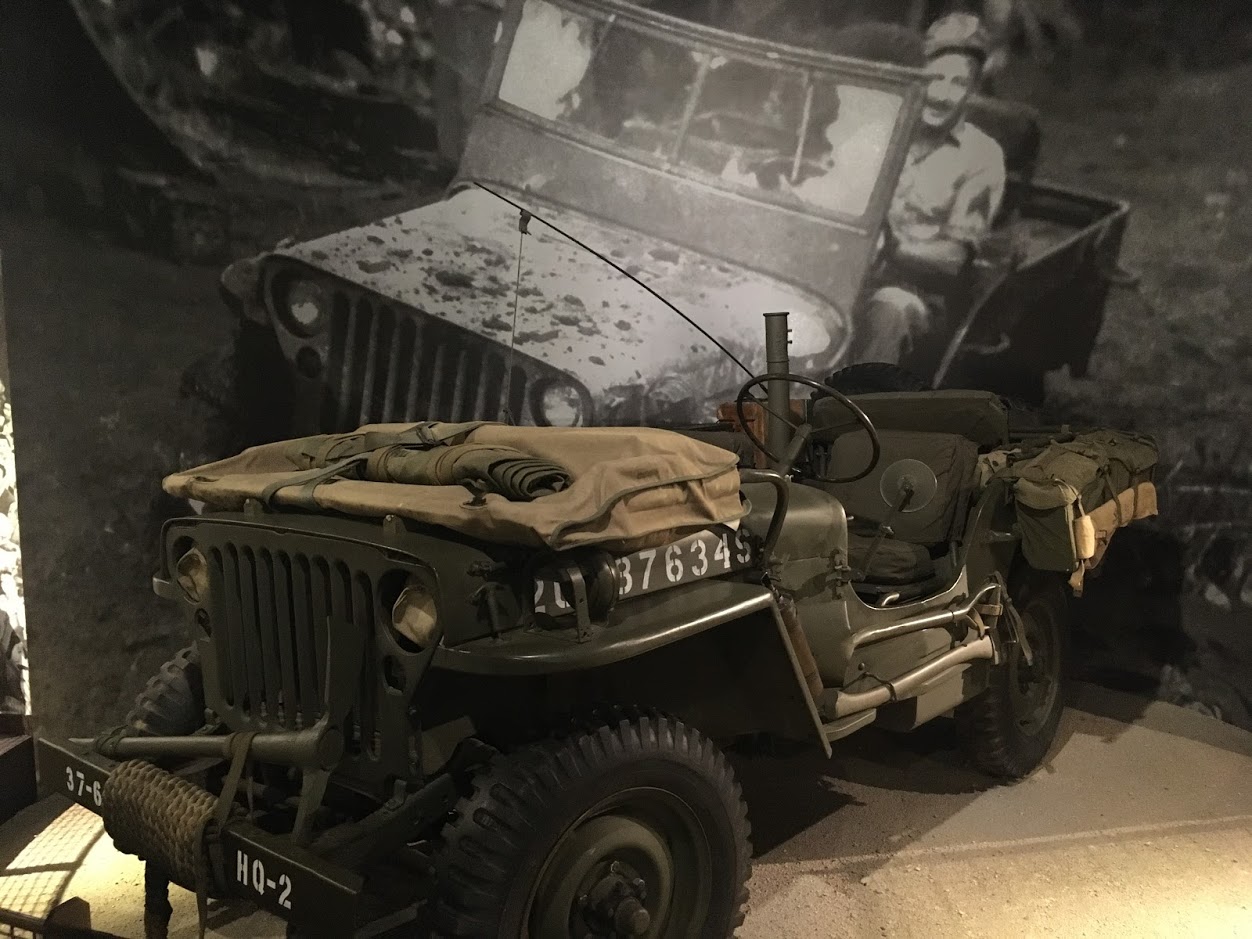
A replica of a WWII jeep. This vehicle was constructed by women. Between 1942 and 1944, the number of women working in American military factories increased 37 percent. One might have seen the "Rosie the Riveter" image on their streets; this was created for the government's mobilization effort.

Since the Pacific Ocean covers so much ground, American soldiers had to often travel via aircraft. The museum houses a massive bomber plane, which not only was used to transport ground forces, but was also utilized in raids on Japanese cities and industrial areas.

Artifacts and military gear of a WWII Japanese soldier. Not all Japanese soldiers treated American prisoners harshly; some shared food and cigarettes, and failed to carry out execution orders.

A replica of a powerful automatic machine gun used by American soldiers on the Pacific Front.

After two years of neutrality, the United States entered the war on the Allies side when Japanese planes attacked American naval vessels at Pearl Harbor on December 7, 1941. The Japanese knew that they had to attack the United States if they were to grow their Pacific Empire; "Japan must be willing to fight America to achieve our national objectives," Lieutenant Colonel Ishiwara Kanji once said. After four hours, the Japanese fighters had shattered the American Pacific fleet; four battleships sunk, two seriously damaged, and two others sustained serious damage. 188 U.S. aircraft were destroyed, and over 2,400 seamen and officers were killed. Following President FDR's famous "a date which will live in infamy" speech, Congress promptly declared war on Japan.

A model of the USS Arizona. Commissioned on October 17, 1916, the USS Arizona was one of the escort ships in President Woodrow Wilson's entourage to Europe following World War I before it was transferred to Pearl Harbor. On December 7, 1941, Japanese torpedo bombers struck the USS Arizona, causing the large vessel to sink, along with 1,177 officers and seamen. A memorial now sits on top of the ship's damaged hull.

Doris "Dorie" Miller, hero of Pearl Harbor. Miller was born on a farm outside of Waco, and enlisted in the U.S. Navy in September 1939 (when Nazi Germany invaded Poland). He was assigned to the USS West Virginia at Pearl Harbor prior to the 1941 attack. At 6 foot, 3 inches, and 225 pounds, "Dorie" was known to be a champion boxer on the ship's decks. After his captain was mortally wounded during the Japanese attack, Miller, who had no gunnery training, began firing a machine gun and blasted a few enemy places from the sky. Owing to his heroic efforts, Miller was the first African-American to be awarded the U.S. Navy Cross. He was later killed in a submarine attack in November 1943.

The Stock Market Crash of 1929 brought the world to its knees. Japan suffered during the early years of the Great Depression and its economy crippled. In an effort to restore its national pride as well as collect natural resources, Japan launched an attack on Manchuria, China in September 1931. Owing to the brilliance of Japanese generals, like the one depicted above, the campaign was successful. With no opposition, Japan continued to grow its Pacific empire before the start of WWII. Japan also left the frail League of Nations, further jeopardizing world peace.

Japan has had a long, complicated history of emperors, royal dynasties, and power-hungry officials. Japan and Russia fought over Korea during the 1904-1905 Russo-Japanese War. President Teddy Roosevelt assisted in the treaty negotiations. The Japanese victory surprised the western empires and resulted in Japan's emergence as a superior naval superpower.

Monday, May 10, 2021

The Beautiful Enchanted Rock

If you are ever in the Texas Hill Country I would highly recommending hiking up Enchanted Rock, a large mound in the middle of a beautiful West Texas region. One might wonder why I and so many Texans are mesmerized by a huge rock- what is special about Enchanted Rock? Not only is the landmark very handsome, Enchanted Rock has a fascinating history and cultural vibe. It is situated on Big Sandy Creek, estimated 18 miles north of Fredericksburg and straddling the border of Gillespie and Llano Counties. This was one of the sites of my November 2020 honeymoon; my wife and I enjoyed hiking to the rock's summit and gaping at Texas's natural areas.

Ready to hike Enchanted Rock. The trek was exhausting, but well worth the trip!


Humans have camped in the Texas Hill Country for over 12,000 years. Indigenous peoples used to ground their food on the granite rocks that are currently found around Enchanted Rock (they left depressions in the granite called bedrock mortars). Following the Spanish conquest of Mexico, Texas, and the American Southwest in the eighteenth century, a mission and presidio was established on the San Saba River. The Spanish also tried to create a silver mine on Honey Creek, yet were unsuccessful. Americans and Germans settled in the Hill Country area starting in the mid-nineteenth century in hopes of acquiring a sizable plot of land and following the American Dream. Despite the Anglo settlements quickly sprouting in the area, the Natives continued to inhabit Enchanted Rock and its surrounding lands, provoking tension between the two distinct groups. Indians attacked a small surveying group at Enchanted Rock in 1841. Texas Rangers Captain John Coffee Hays was cut off from his troupe and forced to retreat in a depression at the summit. There, he fought off his attackers for three hours before his companions came to his aid. A historical plaque on the rock commemorates this event.

A panorama of the Texas Hill Country, taken at the Enchanted Rock summit.


Enchanted Rock's history is covered in myths and legends, according to the old-town folks who live in the Texas Hill Country. The Tonkawa Indians believed that ghost fires flickered on top of the rock; the curious creaking and groaning coming from the mound frightened them. Geologists and scientists later concluded that the rock creaks as the temperature changes and glitters on clear nights after rainfall. Once, an Indian maiden saw her entire tribe get slaughtered by white men; horrified at the brutality, she threw herself off the top of the rock, and her spirit continues to haunt the mound. Also, a Spanish conquistador escaped the clutches of the Indigenous peoples and lived the rest of his life in hiding. The Indians believed the escapee wove enchantments on the area, thus giving rise to a noted legend of a "pale man swallowed by a rock and reborn as one of their own."

Texas is vast... looking out west from the summit.


The Enchanted Rock Natural Area was owned by local businessman Charles Moss in the mid-twentieth century before the Nature Conservancy of Texas purchased the property in 1978. The 1,640.5-acre property was later sold to the State of Texas. Enchanted Rock became a tourist hub in October 1978, and visitors have continued to trek the park each year (Enchanted Rock attracts more than 250,000 guests each year making the area one of the most visited parks in the state park system). Home of several hundred unique species and habitats as well as over 400 protected archeological sites, Enchanted Rock is a National Natural Landmark, and is on the National Register of Historic Places as an Archeological District. The trails are beautiful, the nature is refreshing and the scenery is picturesque. Climber Matt Twyman's account sums up Enchanted Rock's enchantress: "My heart feels lighter, my mind feels calmer and my sense feel tuned whenever I see that giant pink rock on the horizon. No matter how I choose to spend my time among the enchanted rocks of the park, I always leave feeling better than when I arrived."

I enjoyed driving down the quiet, calm roads in the Texas Hill Country. Where will I travel next?

The entrance to Enchanted Rock.

Enchanted Rock's summit is marked by a simple plaque.

Texas has a diverse, vibrant landscape.

A small canyon on the east side of Enchanted Rock; it was fun walking through the thickets. 

There are a couple of bodies of water around Enchanted Rock. This one is located to the south.

Notice the different shades of rock on the west side of Enchanted Rock.

Enchanted Rock is breathtaking. I often compare it to the Garden of the Gods Park in Colorado Springs.